draconica: An anime picture of a white dragon with blue horns that stares into your soul (Default)
One thing you can do with digital notes that you can't do with hand-written notes is compacting your writing. On paper (n.p.i.), you may technically rewrite the same sentence more concisely, but the old text is still there, it's not gone, unless you physically destroy it. Digital data is much easier destroyed (unless it's already been published and redistributed), and that's its special superpower over physical writing besides the ease of copying. This allows dozens effortless ad-hoc approaches that will result in compact writing by iterating quickly. You can even unfold the entire sequence of iterations in the same paragraph and then swiftly delete all sentences you don't feel are right, if you feel like it.
 
Why even bother compacting your writing? The primary use case I had in mind is summarizing the writing of others. By compacting your summaries (removing redundancies, generalizing, maybe even replacing examples with your own instances you find easier to understand), you make it so much easier to 1. memorize the content of the work; 2. internalize it; 3. build upon the ideas you're summarizing. You read a sentence and the entire universe of associations and recollections arises - this is how reading a compact summary carefully written by yourself feels.
 
draconica: An anime picture of a white dragon with blue horns that stares into your soul (Default)

If you are, I'm not going to challenge that claim, it wouldn't be wise.

What makes people wise? We know that wisdom is not intelligence. That can be simulated by a machine. Artificial wisdom, though, now that ain't gonna happen, is it?

We know that old people are wise, at least that's what old people tell us. We know children are wise—well, sometimes. We know our friend who gave us an unexpected good advice was wise, because what they said didn't come from good logic, or private knowledge, or special experience; rather, it came out of nowhere. If intuition is the gut feeling, wisdom must be the gut knowing.

Why is it important to think about wisdom? Because it has the property of transcending our daily experience. Daily experience can be a bit like a maze full of mirrors. You sort of think you know where you're going, but you're also likely to fail to notice you're going in circles. The reality is constructed (don't believe in that? I will make a post about this later), and skillful construction of your own reality depends a lot on your ability to notice what's not in your construction. What doesn't fit in. What does fit, but hasn't been internalized. What has been internalized, but hasn't been put in practice. Sure, intelligence can do all of that, too, but at the cost of straining your imagination and creativity, and wisdom is just sort of there, and you reach for it and there you go.

How does one become wise? By non-attaching. By not believing you know everything. By removing filters and obstacles, by letting your gut think out loud. You get wiser as you let that guy do the job, because it's like a muscle, you let it work and it gets better. That's how you any quality, actually: practice it.

But how do I know all this?

You know, this is just what people tend to say on this topic, I'm not an expert…

Ziggurat

Sep. 17th, 2025 08:02 pm
draconica: An anime picture of a white dragon with blue horns that stares into your soul (Default)
I cannot stand when communication is built on lies, omissions, hints, manipulations, obfuscation, devaluation, or shifting focus—when directness is not the goal but a tool; when closeness is not a bond but a trick; when one person uses another while the other believes they are loved; when openness is seen as weakness and the pursuit of openness as intrusive; when collaboration is a temporary inconvenience rather than a belief in shared effort; when unnecessary words are spoken at the most convenient times; and necessary ones are postponed for better days. When two waves collide in this way, it’s not an overlap but a decay. It’s the rusting of souls. This is mutual torment, and if someone finds profit in it and seeks it, that person deserves loneliness.

A Bad Blog

Aug. 23rd, 2025 11:49 am
draconica: An anime picture of a white dragon with blue horns that stares into your soul (Default)

I'm approaching this blog as a Bad Blog — as in "to write one good blog, write 1000 bad ones."  

The number of 1000 is of course a SigmaGrindset-esque exaggeration: truly I tell you, dear reader, that you will see great improvements in a selected creative skill much earlier than only after wading through 1000 attempts. If anything, at 1000 pieces written your skill will plateau so much your recent works will be roughly at the same quality level and you will be yearning for real improvement and have to try radical changes in your strategy which will bring the quality down, because the New is the Unknown, the Fresh is unexperienced: inexperienced. To grow beyond oneself is to become a nobody once again. You will not always write bad blogs, but you will always write a Bad Blog.

"To do the same thing over and over and expect changes" is called madness by the character Vaas from the 2012 video game FarCry 3. Personally I call this training, and everybody calls this training, we kind of expect that by repeating the same motions we get better at them, which is a change. We kind of expect that because it kind of actually happens, see figure 1 for an example from the Academic Literature.
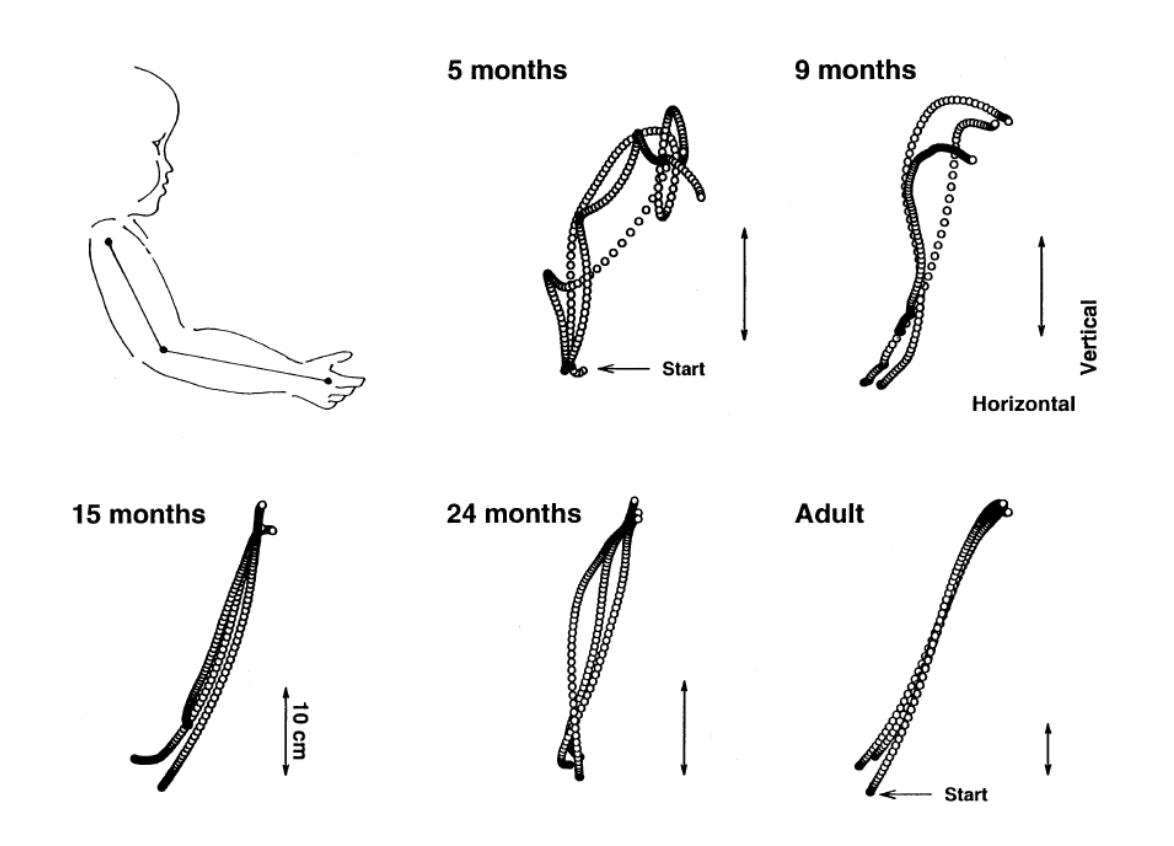
Evolution of reaching trajectories in infants. At 5 months it's wonky and unstable, in adults it's straight and elegant.
Figure 1. Evolution of reaching trajectories in infants. At 5 months it's wonky and unstable, in adults it's straight and elegant. [Konczak and Dichgans, 1997]
 

This phrase by Vaas about madness has been memed on so hard for many years that I wanted to talk about it. The thing about Vaas is that he's an anti-growth person, he doesn't believe in growth, he believes in a fixed hierarchy where every person belongs somewhere by default and yearning to change things is considered madness in his eyes. It was so easy for him to fall into this trap because he lived in the isolated community where he killed everyone who disagreed with him. So I don't know, maybe Vaas is wrong?

Personally, I'm a pro-growth person. I like writing a Bad Blog again and again, because every once in a while I feel "ooh, this one wasn't that bad actually" and I'm proud of myself and I experience bliss. Not madness. What's the point of being mad at anything? "Aaaah im so mad im not good enough" holy crap, kid, now that's the real road towards insanity.

Also, did you know that properly adding paragraphs in Dreamwidth is done by pressing Shift+Enter? If you just use Enter for this purpose, the rich text editor enters a short-lived psychotic episode each time. But Shift+Enter works like a charm.

References

[Konczak and Dichgans, 1997] Konczak, J. and Dichgans, J. (1997). The development toward stereotypic arm kinematics during reaching in the first 3 years of life. Experimental Brain Research, 117:346–354.

Profile

draconica: An anime picture of a white dragon with blue horns that stares into your soul (Default)
Maria

March 2026

S M T W T F S
123 4567
89 1011121314
15161718192021
22232425262728
2930 31    

Syndicate

RSS Atom

Most Popular Tags

Style Credit

  • Style: Delicate for Ciel by nornoriel

Expand Cut Tags

No cut tags
Page generated Apr. 5th, 2026 05:31 am
Powered by Dreamwidth Studios